The Importance of Artificial Intelligence (AI)
Artificial Intelligence (AI) is one of the most important technological developments of the modern era. It refers to the ability of machines and computer systems to perform tasks that normally require human intelligence, such as learning, reasoning, problem-solving, decision-making, and understanding language. AI has become a significant part of our daily lives, influencing the way we work, communicate, learn, and interact with the world around us.
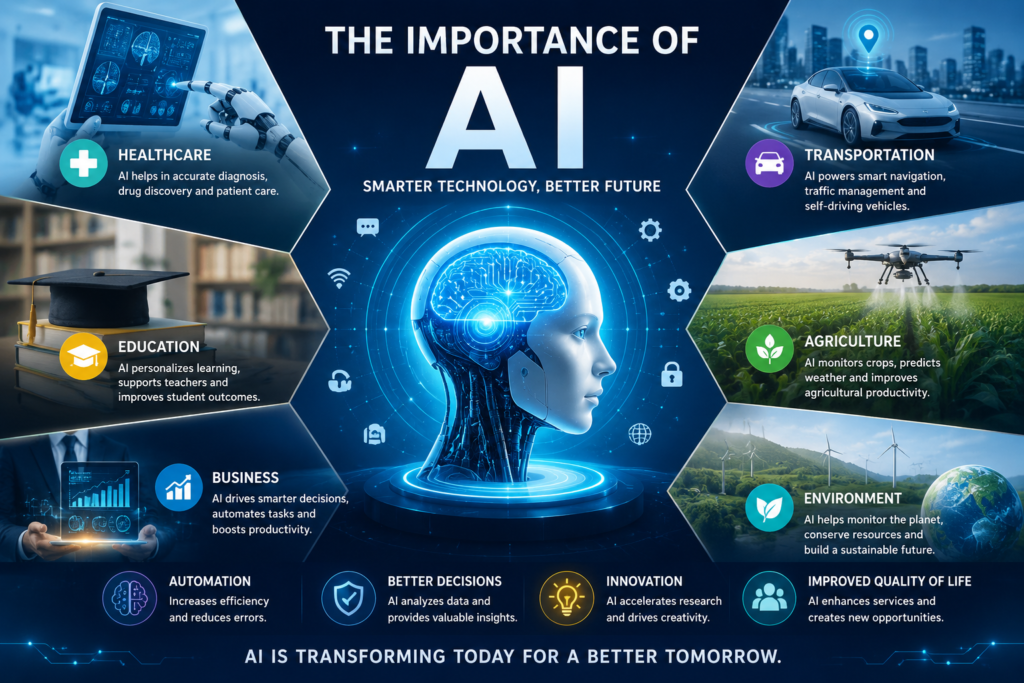
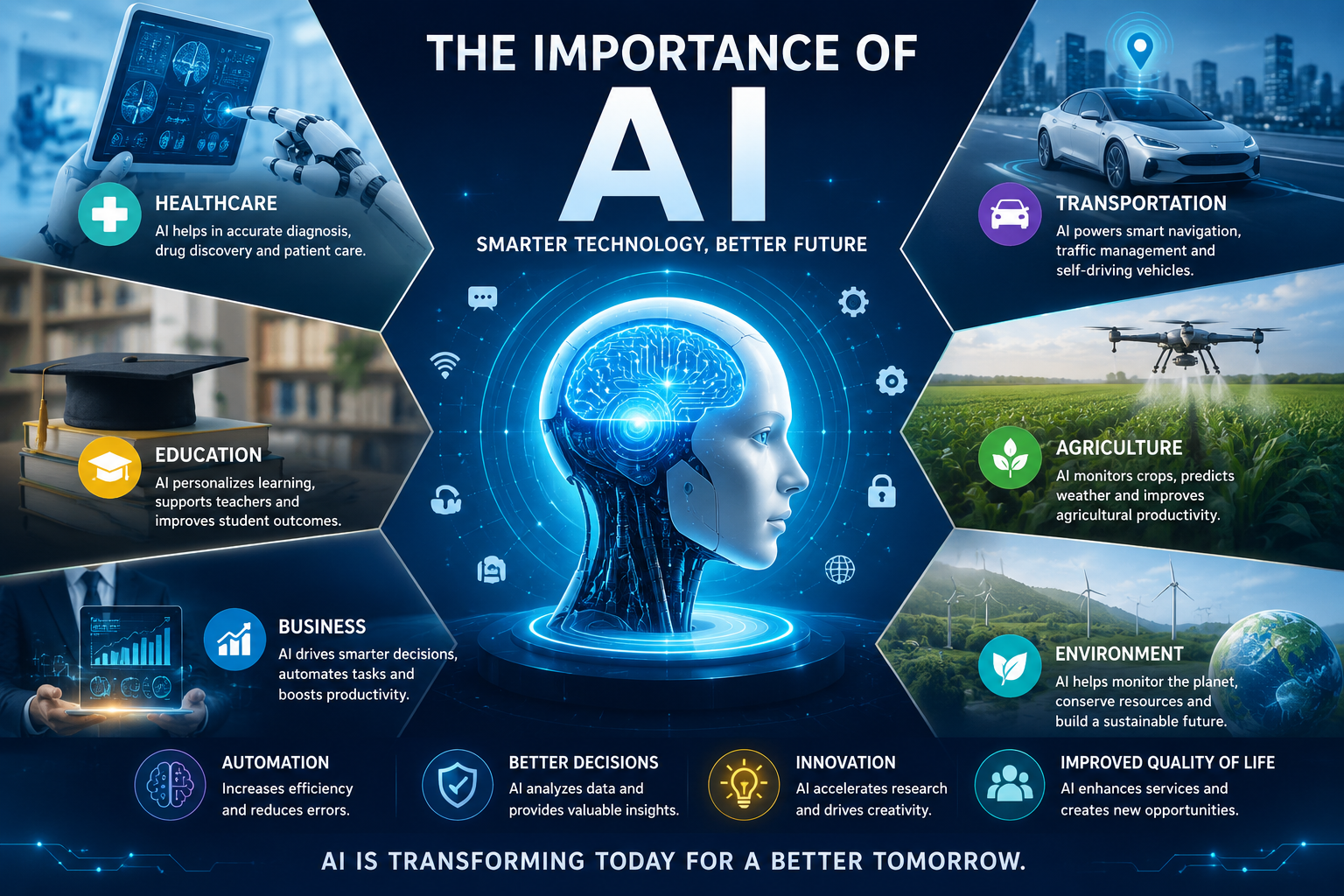
The importance of AI can be seen in almost every sector of society. In healthcare, AI helps doctors diagnose diseases more accurately and quickly. Advanced AI systems can analyze medical images, detect health problems, and assist in creating treatment plans. AI-powered tools also help researchers discover new medicines and improve patient care. As a result, healthcare services become more efficient, accessible, and reliable.
In education, AI is transforming the learning experience. Intelligent tutoring systems can provide personalized lessons based on a student’s learning speed and abilities. Educational platforms use AI to recommend learning materials, assess performance, and offer instant feedback. This helps students learn more effectively and allows teachers to focus on improving educational outcomes.
The business world greatly benefits from AI technology. Companies use AI to analyze customer behavior, predict market trends, and automate repetitive tasks. AI-powered chatbots provide customer support around the clock, improving customer satisfaction while reducing operational costs. Businesses can make better decisions by using AI-driven data analysis, leading to increased productivity and profitability.
Transportation is another field where AI plays a crucial role. AI systems are used in navigation applications, traffic management, and the development of self-driving vehicles. These technologies help reduce traffic congestion, improve road safety, and enhance transportation efficiency. In the future, AI-driven transportation systems may revolutionize how people travel and move goods across the world.
AI is also important in agriculture. Farmers use AI-based technologies to monitor crop health, predict weather conditions, and optimize irrigation systems. These innovations help increase agricultural productivity while reducing waste and environmental impact. As the global population continues to grow, AI can play a key role in ensuring food security.
In the financial sector, AI helps banks and financial institutions detect fraudulent activities, manage risks, and provide personalized financial services. AI algorithms can analyze large amounts of financial data within seconds, enabling faster and more accurate decision-making. This improves security and efficiency in financial operations.
Artificial Intelligence contributes significantly to scientific research and innovation. Researchers use AI to analyze complex datasets, simulate experiments, and discover patterns that would be difficult for humans to identify. AI accelerates progress in fields such as astronomy, biology, chemistry, and environmental science. By processing vast amounts of information quickly, AI enables scientists to solve complex problems more effectively.
The entertainment industry has also embraced AI. Streaming services use AI to recommend movies, music, and television shows based on user preferences. Video game developers create smarter and more realistic characters using AI technology. Content creators use AI tools for video editing, graphic design, and content generation, enhancing creativity and productivity.
One of the greatest advantages of AI is automation. AI-powered systems can perform repetitive and time-consuming tasks with high accuracy and speed. This allows humans to focus on more creative, strategic, and meaningful activities. Automation improves efficiency in manufacturing, logistics, customer service, and many other industries.
AI also plays an important role in environmental protection. Scientists use AI to monitor climate change, track wildlife populations, and manage natural resources more effectively. AI can help identify environmental threats and develop sustainable solutions to protect the planet for future generations.
Despite its many benefits, AI also presents challenges. Concerns about privacy, data security, job displacement, and ethical decision-making must be addressed carefully. Governments, organizations, and technology developers need to establish responsible guidelines for the development and use of AI. Ensuring fairness, transparency, and accountability is essential for maximizing the benefits of AI while minimizing potential risks.
The future of Artificial Intelligence is extremely promising. As technology continues to advance, AI is expected to become even more integrated into everyday life. It will help solve global challenges, improve living standards, and create new opportunities for innovation and economic growth. AI has the potential to transform industries, improve public services, and enhance human capabilities in ways that were once considered impossible.
In conclusion, Artificial Intelligence is a powerful technology that is reshaping the world. Its importance extends across healthcare, education, business, transportation, agriculture, finance, research, entertainment, and environmental protection. By increasing efficiency, improving decision-making, and driving innovation, AI is helping society progress toward a smarter and more connected future. While challenges remain, responsible development and use of AI can ensure that its benefits are shared by people around the world.
