Artificial Intelligence (AI): The Technology Transforming the World
Introduction
Artificial Intelligence (AI) has become one of the most talked-about technologies in the world. From chatbots and virtual assistants to self-driving cars and medical diagnosis, AI is changing how people live, work, and communicate. In 2026, AI is no longer a futuristic concept—it is part of everyday life. Businesses, students, content creators, and professionals are using AI tools to improve productivity and solve complex problems.
This article explores what AI is, how it works, its applications, benefits, challenges, and what the future may hold.
What Is Artificial Intelligence?
Artificial Intelligence is a branch of computer science that focuses on creating machines and software capable of performing tasks that normally require human intelligence. These tasks include learning, reasoning, problem-solving, understanding language, recognizing images, and making decisions.
Unlike traditional software, AI systems can analyze data, identify patterns, and improve their performance over time.
Types of Artificial Intelligence
1. Narrow AI
Narrow AI is designed to perform a specific task. Examples include voice assistants, recommendation systems, and language translation tools.
2. General AI
General AI refers to machines that could perform any intellectual task a human can do. This technology remains under development.
3. Super AI
Super AI is a theoretical concept where machines surpass human intelligence in every field. It remains speculative and has not been achieved.
How AI Works
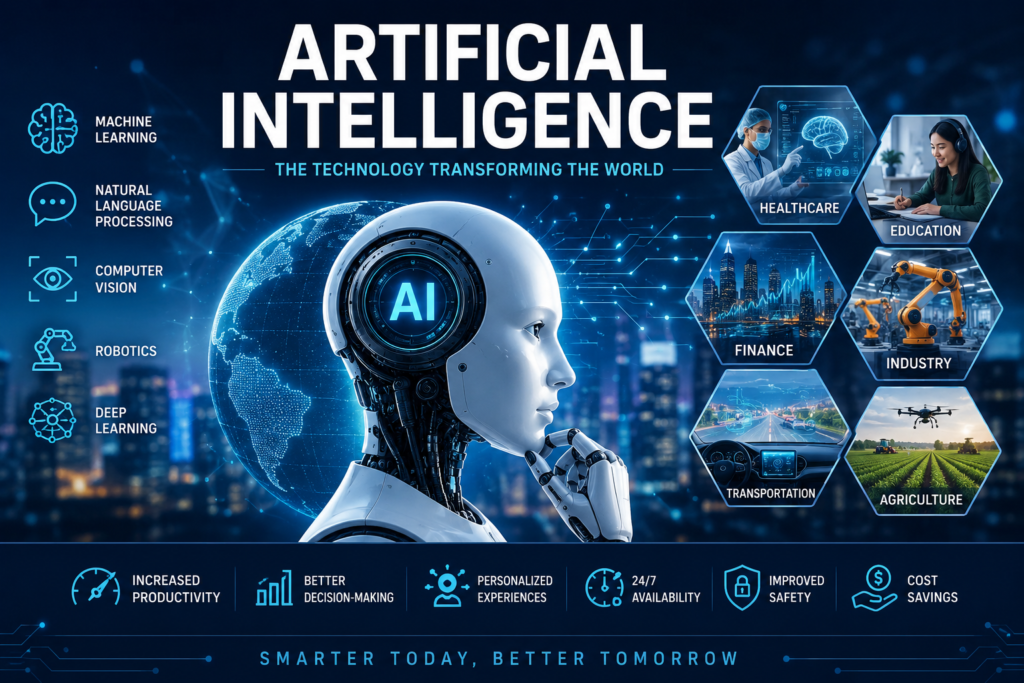
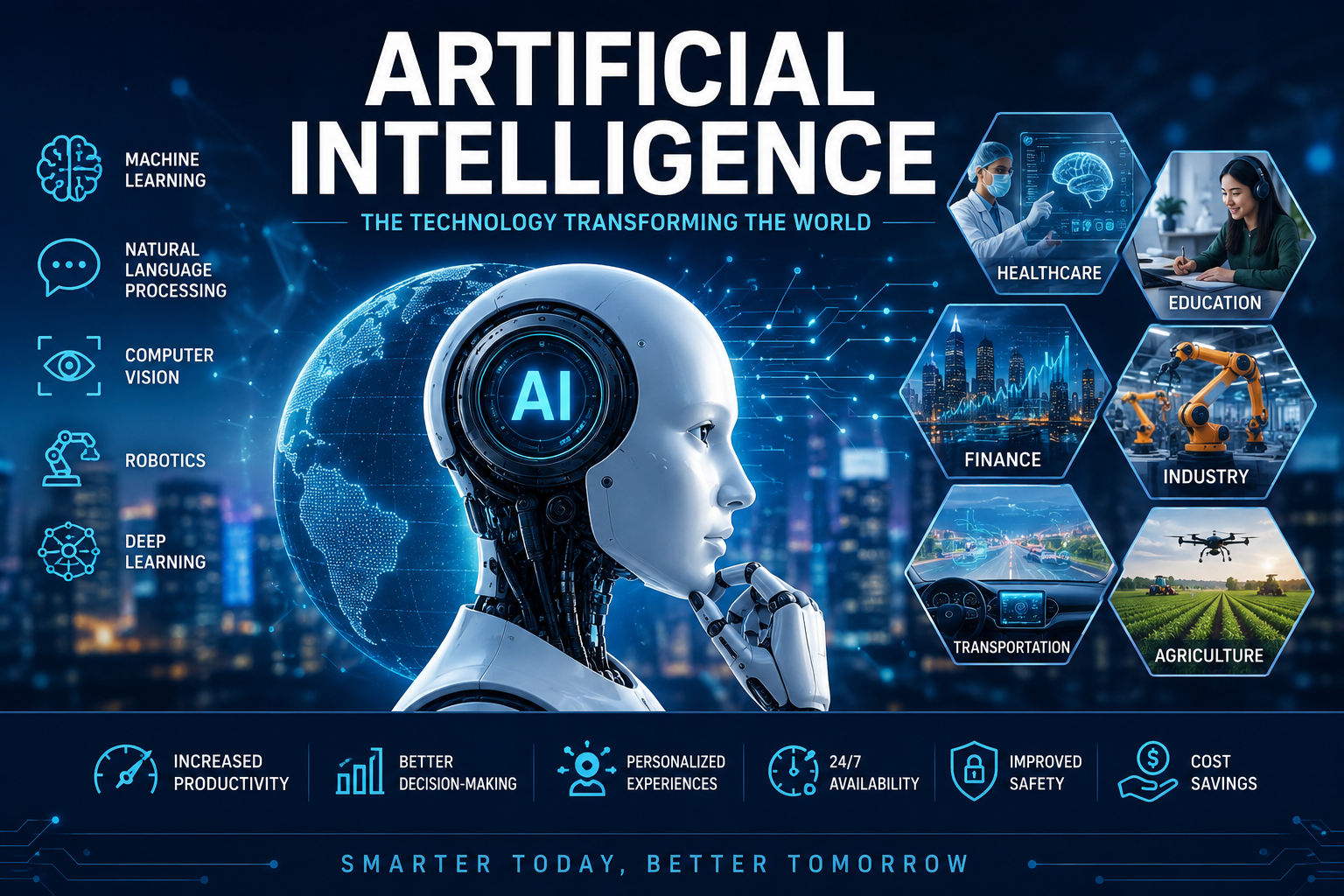
AI relies on several technologies, including:
- Machine Learning
- Deep Learning
- Neural Networks
- Natural Language Processing (NLP)
- Computer Vision
- Robotics
These technologies enable computers to learn from data instead of following only fixed instructions.
Applications of AI
Healthcare
AI helps doctors detect diseases, analyze medical images, develop medicines, and monitor patients more efficiently.
Education
Students use AI tutors for personalized learning, language practice, research, and homework assistance.
Business
Companies use AI for customer support, marketing, sales forecasting, fraud detection, and automation.
Content Creation
Writers, designers, and video creators use AI to generate articles, graphics, videos, voiceovers, and subtitles faster than ever before.
Finance
Banks use AI for fraud detection, credit scoring, investment analysis, and customer service.
Transportation
AI powers navigation systems, traffic management, and research into autonomous vehicles.
Agriculture
Farmers use AI to monitor crops, predict weather patterns, optimize irrigation, and improve harvests.
Benefits of AI
- Increased productivity
- Faster decision-making
- Reduced human error
- 24/7 availability
- Personalized services
- Better healthcare outcomes
- Improved education
- Cost savings for businesses
Challenges and Risks
Despite its advantages, AI also raises important concerns:
- Privacy and data security
- Job displacement through automation
- Bias in AI systems
- Spread of misinformation
- Ethical questions about decision-making
- Cybersecurity threats
Governments and technology companies are working to develop responsible AI policies and safety standards.
AI and the Future of Work
AI is changing the job market. While some repetitive jobs may disappear, many new careers are emerging, including:
- AI Engineer
- Machine Learning Specialist
- Prompt Engineer
- Data Scientist
- AI Ethics Consultant
- Robotics Technician
People who learn AI-related skills will have strong career opportunities in the coming years.
AI for Students
Students can use AI to:
- Learn new subjects
- Practice languages
- Improve writing
- Solve mathematical problems
- Prepare for exams
- Organize study schedules
However, AI should be used to support learning rather than replace critical thinking.
AI for Businesses
Businesses of all sizes benefit from AI by automating repetitive tasks, improving customer experiences, analyzing market trends, and increasing efficiency. Small businesses can also use affordable AI tools for marketing, customer support, and content creation.
The Future of AI
Experts believe AI will continue advancing rapidly. Future developments may include more capable robots, smarter healthcare systems, personalized education, improved climate research, and scientific discoveries. Responsible development will be essential to ensure AI benefits society while minimizing risks.
Conclusion
Artificial Intelligence is transforming nearly every aspect of modern life. It is helping people work more efficiently, solve complex problems, and create new opportunities across industries. While challenges remain, responsible innovation and education can ensure AI continues to improve lives around the world. Understanding AI today is an investment in the future, as it is expected to remain one of the most influential technologies for decades to come.
