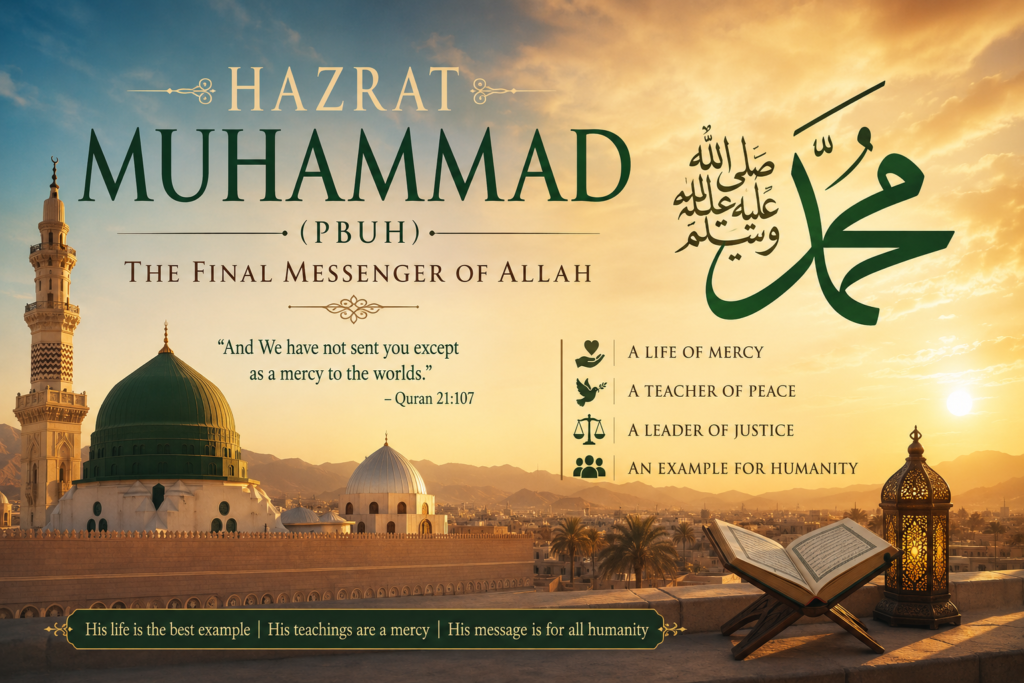
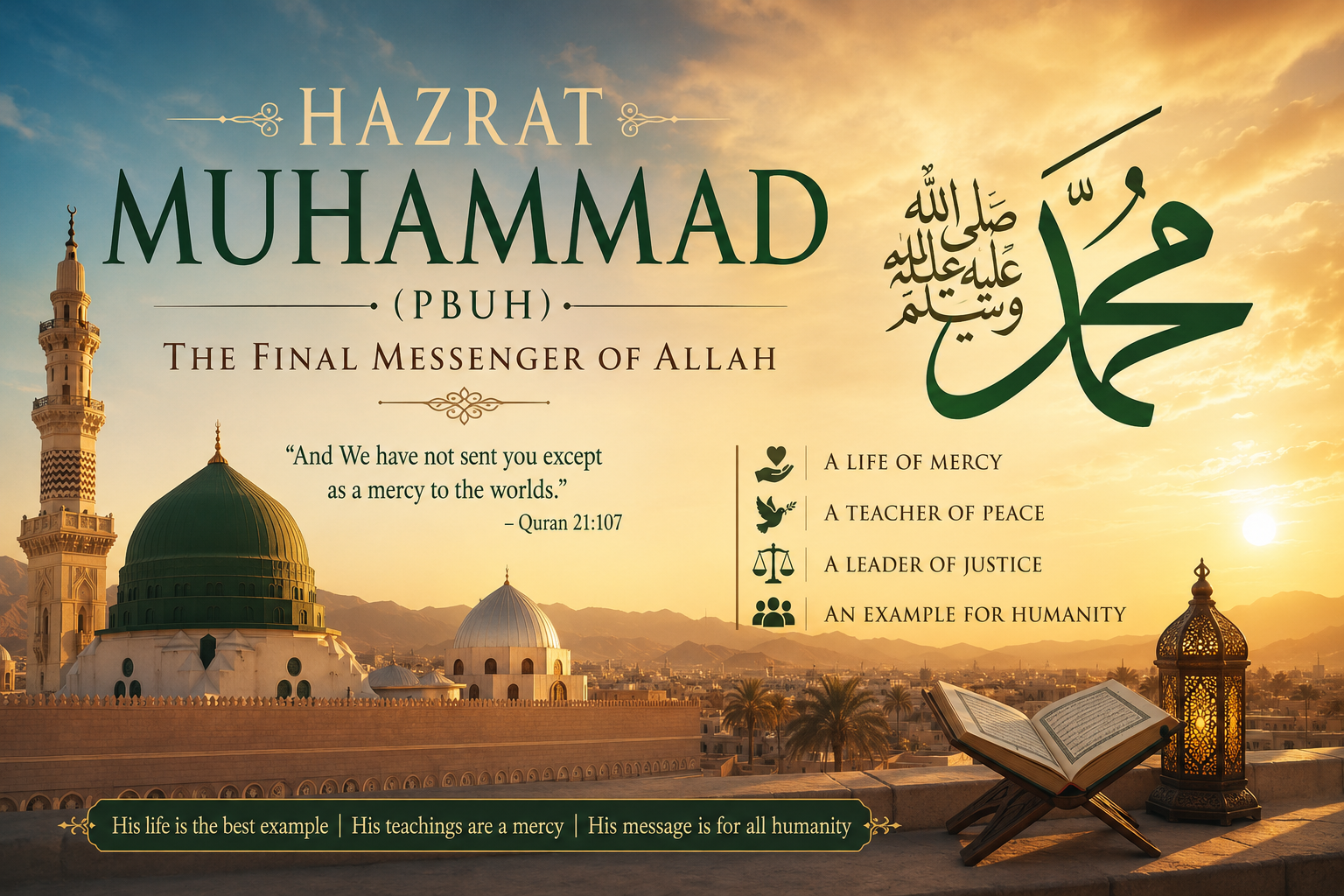
Hazrat Muhammad (PBUH): A Detailed Biography of the Last Messenger of Allah
Introduction
Hazrat Muhammad (Peace Be Upon Him) is the final Prophet and Messenger of Allah according to Islam. His life is regarded by Muslims as the perfect example of faith, morality, justice, mercy, and leadership. Born in the Arabian Peninsula during a time of widespread tribal conflict and idol worship, he transformed society through the message of Islam. His teachings continue to inspire more than a billion Muslims worldwide.
The Holy Quran describes him as:
“And We have not sent you except as a mercy to the worlds.” (Quran 21:107)
Historical Background
Before the birth of Prophet Muhammad (PBUH), Arabia was in a period known as Jahiliyyah (the Age of Ignorance). Society was marked by:
- Idol worship
- Tribal warfare
- Social injustice
- Oppression of women
- Economic exploitation
- Slavery
- Lack of moral guidance
Allah chose Prophet Muhammad (PBUH) to guide humanity from darkness to light.
Birth and Family
Prophet Muhammad (PBUH) was born in Mecca in 570 CE, known as the Year of the Elephant.
His family belonged to the noble Banu Hashim clan of the Quraysh tribe.
His Parents
- Father: Abdullah ibn Abd al-Muttalib
- Mother: Aminah bint Wahb
His father passed away before his birth.
Childhood
Like many Arab children, he was cared for in infancy by Halimah al-Sa’diyah.
At six years old, his mother passed away.
At eight years old, his grandfather Abd al-Muttalib also passed away.
His uncle Abu Talib then became his guardian and protected him throughout much of his life.
Youth
As a young man, Muhammad (PBUH):
- Worked as a shepherd.
- Later became a successful merchant.
- Earned the titles Al-Amin (The Trustworthy) and As-Sadiq (The Truthful) because of his honesty and integrity.
People trusted him with their wealth and valued his fair dealings.
Marriage to Khadijah (RA)
At the age of 25, Prophet Muhammad (PBUH) married Khadijah bint Khuwaylid, who was forty years old and a respected businesswoman.
Their marriage lasted twenty-five years and was marked by mutual love, loyalty, and support. Khadijah (RA) was the first person to embrace Islam.
Their children included:
- Qasim ibn Muhammad
- Zainab bint Muhammad
- Ruqayyah bint Muhammad
- Umm Kulthum bint Muhammad
- Fatimah bint Muhammad
- Abdullah ibn Muhammad
The First Revelation
At the age of forty, while worshipping in the Cave of Hira, Angel Jibril brought the first revelation.
The first revealed verses were:
“Read in the name of your Lord who created.”
This marked the beginning of prophethood.
Early Muslims
The earliest people to accept Islam included:
- Khadijah bint Khuwaylid
- Ali ibn Abi Talib
- Zayd ibn Harithah
- Abu Bakr
The Message of Islam
The Prophet (PBUH) taught:
- Belief in One God (Allah)
- Prayer
- Charity
- Fasting
- Justice
- Equality
- Mercy
- Forgiveness
- Respect for parents
- Kindness to neighbors
- Care for the poor
- Protection of orphans
- Good treatment of women
- Honesty in business
Persecution in Mecca
The Quraysh opposed Islam because it threatened their religious and economic interests.
Muslims faced:
- Torture
- Boycotts
- Social isolation
- Confiscation of property
- Physical violence
Despite these hardships, the Prophet (PBUH) remained patient and steadfast.
The Hijrah (Migration)
In 622 CE, Prophet Muhammad (PBUH) and his followers migrated to Medina.
This event, known as the Hijrah, marks the beginning of the Islamic calendar.
In Medina, he established a community based on justice, cooperation, and mutual respect.
Major Battles
To defend the Muslim community, several significant battles took place, including:
- The Battle of Badr
- The Battle of Uhud
- The Battle of the Trench
These battles are remembered as important events in early Islamic history.
Treaty of Hudaybiyyah
The Treaty of Hudaybiyyah established a period of peace between the Muslims and the Quraysh. Although some companions initially found its terms difficult, it eventually helped create conditions in which many more people embraced Islam.
Conquest of Mecca
In 630 CE, Prophet Muhammad (PBUH) entered Mecca peacefully with his followers.
He forgave those who had persecuted him for years and declared a general amnesty.
He removed the idols from the Kaaba, restoring it as a place dedicated to the worship of Allah alone.
The Farewell Pilgrimage
In 632 CE, the Prophet performed his final Hajj and delivered the Farewell Sermon, emphasizing:
- Equality of all people
- Justice
- Respect for women
- Sanctity of life and property
- Brotherhood
- Following the Quran and his example
This sermon remains one of the most influential addresses in Islamic history.
Personal Character
Hazrat Muhammad (PBUH) was known for:
- Truthfulness
- Trustworthiness
- Humility
- Patience
- Mercy
- Courage
- Wisdom
- Generosity
- Forgiveness
- Modesty
Even his opponents acknowledged his honesty and noble conduct.
His Legacy
Prophet Muhammad (PBUH) united the tribes of Arabia under the message of Islam and laid the foundations of a community centered on worship, justice, learning, and compassion. His teachings continue to guide Muslims in matters of faith, family life, ethics, and social responsibility.
Conclusion
Hazrat Muhammad (Peace Be Upon Him) is revered by Muslims as the final Messenger of Allah and an enduring example of righteousness. His life demonstrates how faith, compassion, wisdom, patience, and justice can transform individuals and societies. More than fourteen centuries after his passing, his message continues to inspire millions to seek moral excellence, serve humanity, and strengthen their relationship with Allah.
