Introduction
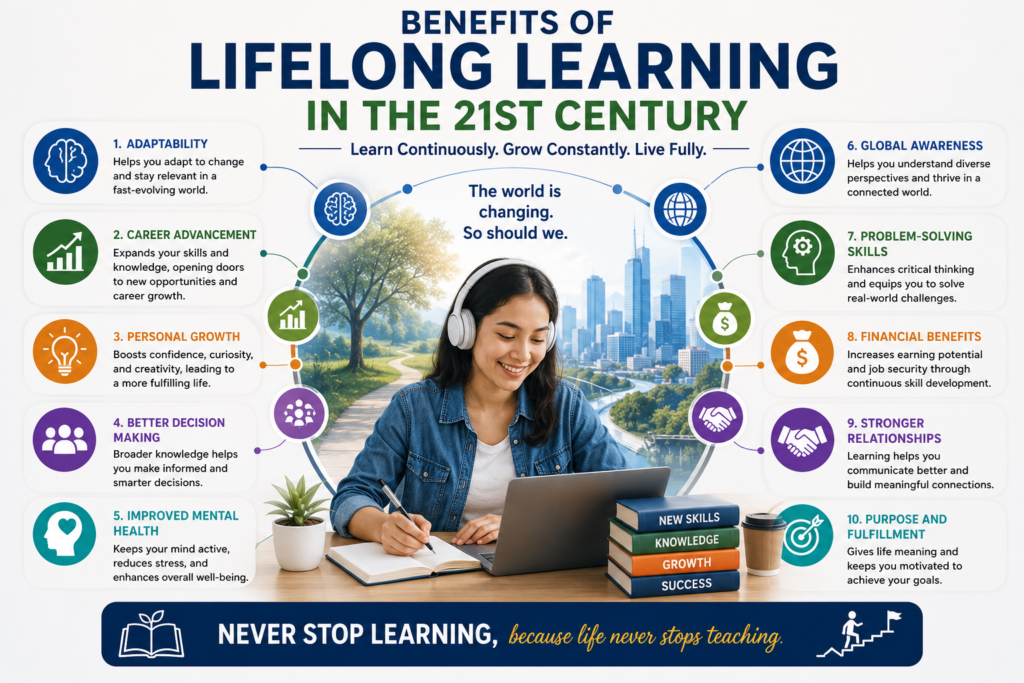
In the 21st century, change has become constant. Technology evolves rapidly, industries transform, and new skills are required at an increasing pace. In this dynamic environment, learning can no longer be limited to school or university years. Instead, it must continue throughout life. This ongoing process is known as lifelong learning. It involves continuously developing knowledge, skills, and attitudes to adapt to personal, social, and professional changes. Lifelong learning has become essential for success, relevance, and personal fulfillment in today’s world.
Adapting to Rapid Technological Change
One of the biggest advantages of lifelong learning is the ability to keep up with technological advancements. New tools, software, and digital systems are constantly being introduced in nearly every field. Individuals who continue learning are better equipped to understand and use these technologies effectively.
For example, careers in business, healthcare, engineering, and education now rely heavily on digital skills. Lifelong learners are more adaptable and can easily transition between different technologies, making them more competitive in the job market.
Improving Career Opportunities
Lifelong learning significantly enhances career growth and employability. Employers today value individuals who are willing to upgrade their skills and stay current with industry trends. Continuous learning helps individuals gain new qualifications, improve existing skills, and explore better job opportunities.
It also allows professionals to switch careers or take on new roles within their field. By staying updated, individuals increase their chances of promotions, salary growth, and long-term career stability.
Enhancing Personal Development
Lifelong learning is not only about professional success but also about personal growth. It helps individuals expand their knowledge, develop new interests, and build confidence. Learning new subjects or skills keeps the mind active and engaged, contributing to intellectual growth.
It also encourages curiosity and creativity. People who continuously learn are more open-minded and better able to understand different perspectives, cultures, and ideas. This leads to a more enriched and meaningful life experience.
Strengthening Problem-Solving Skills
Continuous learning improves critical thinking and problem-solving abilities. As individuals are exposed to new information and challenges, they learn how to analyze situations more effectively and make better decisions.
Lifelong learners are often more resourceful and adaptable when facing difficulties. They can apply knowledge from different areas to solve real-world problems, making them more capable in both personal and professional life.
Increasing Social Awareness and Communication Skills
Lifelong learning also helps individuals become more socially aware and effective communicators. By learning about different cultures, societies, and global issues, people develop a broader understanding of the world.
This awareness improves empathy and strengthens relationships with others. In addition, continuous learning enhances communication skills, making it easier to express ideas clearly and interact confidently in both personal and professional settings.
Promoting Mental Health and Cognitive Growth
Engaging in lifelong learning keeps the brain active and healthy. Studies have shown that learning new skills can improve memory, concentration, and cognitive function. It may also help reduce the risk of mental decline as people age.
Learning activities such as reading, problem-solving, and acquiring new hobbies stimulate the brain and keep it engaged. This contributes to overall mental well-being and a more positive outlook on life.
Encouraging Independence and Self-Motivation
Lifelong learners tend to be more independent and self-motivated. Since they take responsibility for their own learning, they develop discipline and a strong sense of purpose. They are not limited by formal education systems and actively seek opportunities to grow.
This independence allows individuals to set their own goals and work toward them at their own pace. It also builds resilience, as learners become more comfortable with change and uncertainty.
Supporting Innovation and Creativity
Continuous learning plays a key role in fostering innovation. When individuals are exposed to new ideas and knowledge, they are more likely to think creatively and develop innovative solutions.
Many breakthroughs in science, technology, and business come from individuals who constantly learn and experiment. Lifelong learning encourages curiosity, which is the foundation of creativity and innovation.
Conclusion
Lifelong learning is essential in the 21st century, where knowledge and technology are constantly evolving. It helps individuals adapt to change, improve career prospects, enhance personal development, and strengthen mental abilities. Beyond professional success, it enriches life by encouraging curiosity, creativity, and continuous growth. In a world that never stops changing, lifelong learning ensures that individuals remain capable, confident, and prepared for the future.
