Introduction
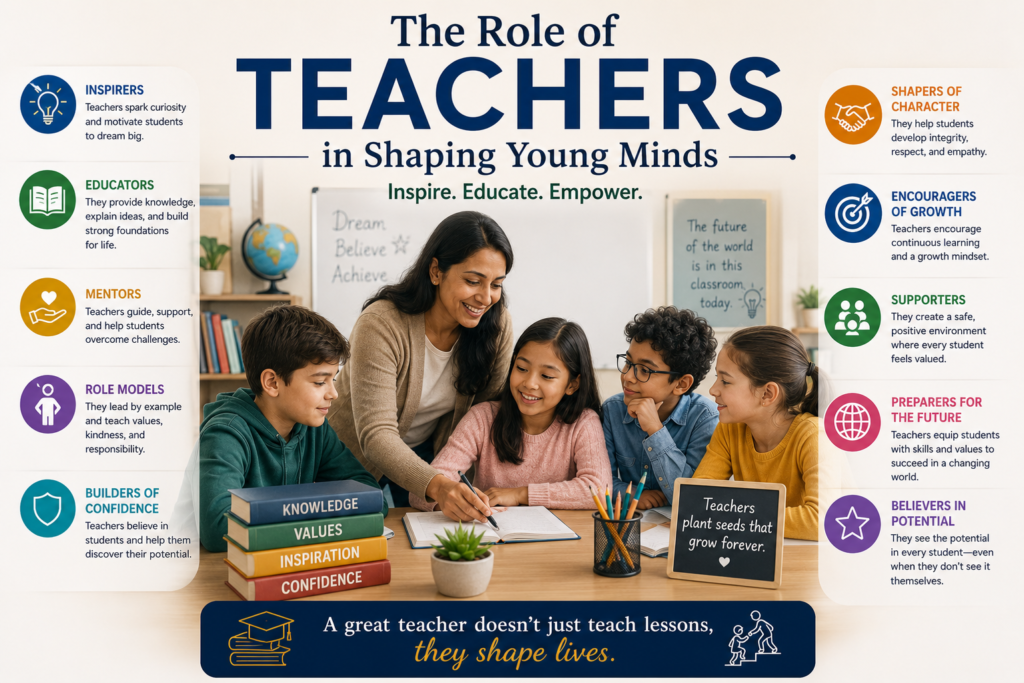
Teachers play one of the most influential roles in society. They are not only responsible for delivering academic knowledge but also for guiding students’ personal growth, shaping their attitudes, and preparing them for future challenges. The impact of a teacher often extends far beyond the classroom, influencing how students think, behave, and contribute to the world around them. In many ways, teachers serve as mentors, role models, and motivators who help shape young minds during their most formative years.
Teachers as Knowledge Providers
The most direct role of a teacher is to provide education and build academic understanding. Teachers simplify complex concepts, explain difficult ideas, and help students develop a strong foundation in various subjects such as mathematics, science, language, and social studies.
However, effective teaching goes beyond memorization. Good teachers focus on ensuring that students truly understand concepts rather than just repeating information. They encourage curiosity and help learners connect classroom knowledge with real-life situations, making education more meaningful and practical.
Encouraging Critical Thinking
Modern education is not just about learning facts; it is about developing the ability to think critically. Teachers encourage students to question ideas, analyze information, and form their own opinions. This helps students become independent thinkers rather than passive learners.
Through discussions, problem-solving activities, and open-ended questions, teachers create opportunities for students to explore different perspectives. This kind of learning prepares young minds to make informed decisions and face real-world challenges with confidence.
Shaping Character and Values
Teachers play a key role in building the moral and ethical foundation of students. They help instill values such as honesty, discipline, respect, responsibility, and empathy. These qualities are essential for personal development and social harmony.
Students often observe and imitate their teachers’ behavior. As a result, teachers naturally become role models whose actions can strongly influence how students treat others and approach life. A supportive and respectful teacher can have a lasting positive impact on a student’s character.
Motivating and Inspiring Students
One of the most powerful contributions of a teacher is motivation. Many students face difficulties such as lack of confidence, fear of failure, or limited resources. A caring and encouraging teacher can help students overcome these barriers.
Teachers inspire students by recognizing their strengths, appreciating their efforts, and pushing them to achieve their potential. Sometimes, a few encouraging words from a teacher can change a student’s outlook and encourage them to pursue goals they once thought were impossible.
Supporting Emotional Development
Young minds are not only developing intellectually but also emotionally. Teachers often act as a source of support for students who face stress, anxiety, or personal challenges. A compassionate teacher can create a safe and supportive classroom environment where students feel understood and valued.
By promoting kindness, cooperation, and emotional awareness, teachers help students develop strong interpersonal skills. These skills are important for building healthy relationships both inside and outside school.
Creating a Positive Learning Environment
A well-managed classroom environment is essential for effective learning. Teachers are responsible for maintaining discipline while also encouraging creativity and participation. A positive classroom atmosphere allows students to feel comfortable expressing their ideas without fear of judgment.
Teachers use different teaching methods, tools, and activities to keep students engaged and motivated. When students enjoy learning, they are more likely to stay focused and perform better academically.
Preparing Students for the Future
Teachers also play an important role in preparing students for life beyond school. They help students develop essential life skills such as communication, teamwork, problem-solving, and time management.
In addition, teachers guide students in choosing career paths by identifying their interests and strengths. This guidance can be crucial in helping students make informed decisions about their future education and profession.
Adapting to Changing Educational Needs
With the advancement of technology and changes in society, the role of teachers is constantly evolving. Modern teachers must adapt to new teaching methods, digital tools, and changing student needs.
By integrating technology into lessons and adopting innovative teaching strategies, teachers make learning more interactive and effective. Their willingness to adapt ensures that students receive relevant and up-to-date education.
Conclusion
Teachers are essential in shaping young minds and building the foundation of a strong society. They educate, inspire, guide, and support students in multiple ways, influencing both academic success and personal development. The lessons learned from teachers often last a lifetime, shaping the values, decisions, and achievements of future generations. A good teacher does not only prepare students for exams but also prepares them for life.
